AI Workflows in MEP: Engineering the Built Environment
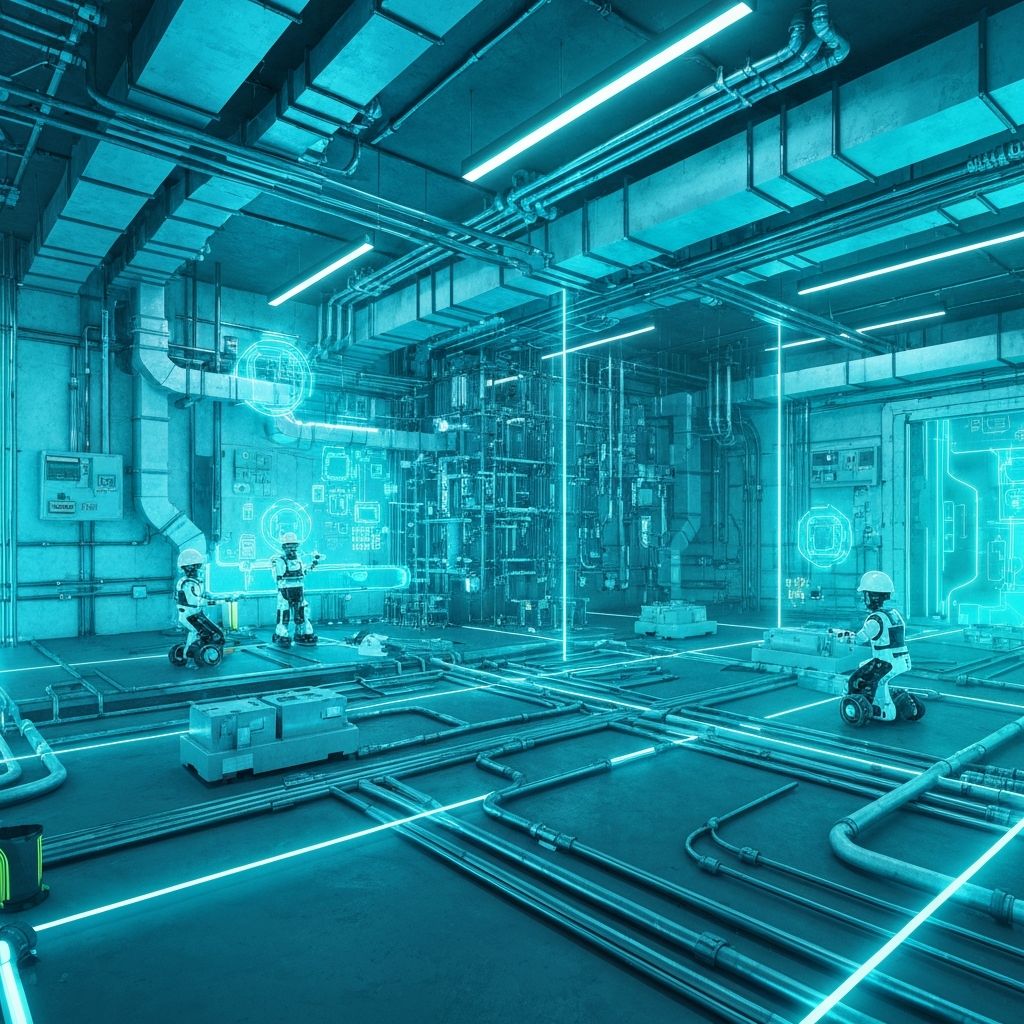
The built environment is undergoing a quiet revolution. In mechanical, electrical, and plumbing (MEP) engineering—the backbone of every building's functionality—artificial intelligence is transforming workflows that have remained largely unchanged for decades. From design optimization to predictive maintenance, AI is enabling engineers to work smarter, deliver better results, and create more sustainable buildings that adapt to their occupants' needs.
Industry Impact
MEP firms implementing AI-driven workflows report 30-45% reduction in design time, 25% decrease in construction conflicts, and 40% improvement in energy efficiency predictions.
Intelligent Design Optimization
MEP design has traditionally been a labor-intensive process requiring engineers to manually route systems, size equipment, and balance countless variables to meet building codes, efficiency standards, and budget constraints. AI is revolutionizing this process through generative design algorithms that can explore thousands of design options in the time it would take a human engineer to evaluate a handful.
These AI systems consider multiple objectives simultaneously—minimizing material costs, optimizing energy efficiency, reducing installation complexity, and maximizing occupant comfort. They can quickly identify design solutions that human engineers might never discover, finding novel routing paths for ductwork and piping that save space and materials while improving performance.
Perhaps most importantly, AI-powered design tools can instantly evaluate how design changes ripple through the entire building system. When an architect moves a wall or changes a floor plan, AI can immediately recalculate optimal MEP routing and equipment placement, turning what was once a days-long rework process into a near-instantaneous update. This responsiveness enables more collaborative design processes and better integration between architectural vision and engineering reality.
Clash Detection and Coordination
In construction, clashes—where different building systems occupy the same space—are costly problems that often aren't discovered until installation is underway. Traditional clash detection requires manual review of 3D models, a time-consuming process prone to human oversight. AI-powered clash detection systems automatically scan building information models (BIM) to identify conflicts not just between physical elements, but also considering installation sequences, access requirements, and maintenance needs.
Advanced AI systems go beyond simple clash detection to intelligent coordination. They can suggest resolution strategies, prioritize which systems should take precedence in tight spaces based on operational requirements, and even automatically generate coordination drawings. These systems learn from past projects, understanding which types of clashes are most critical and which resolution strategies work best in specific scenarios.
Design Phase
- • Generative design optimization
- • Automated code compliance checking
- • Energy modeling and simulation
- • Equipment sizing and selection
- • Cost estimation and value engineering
Operations Phase
- • Predictive maintenance scheduling
- • Fault detection and diagnostics
- • Energy optimization and demand response
- • Occupancy-based system control
- • Performance monitoring and analytics
Predictive Maintenance: From Reactive to Proactive
Once a building is operational, MEP systems require ongoing maintenance to ensure reliability and efficiency. Traditional maintenance follows fixed schedules—changing filters every three months, servicing chillers annually—regardless of actual equipment condition. This approach either wastes resources on unnecessary maintenance or fails to catch problems before they cause failures.
AI-powered predictive maintenance transforms this paradigm by continuously monitoring equipment performance and using machine learning to identify subtle patterns that indicate impending failures. Vibration signatures might reveal bearing wear in a pump weeks before it fails. Temperature anomalies could indicate refrigerant leaks in HVAC systems. Pressure trends might signal filter clogging or duct restrictions.
These systems don't just detect problems—they predict when failures are likely to occur and recommend optimal maintenance timing. This enables facilities teams to schedule repairs during convenient windows, order parts in advance, and avoid emergency service calls. The result is dramatically improved uptime, extended equipment life, and reduced maintenance costs. For critical facilities like hospitals and data centers, predictive maintenance can mean the difference between uninterrupted operation and catastrophic failure.
Energy Optimization: The AI Advantage
Buildings account for nearly 40% of global energy consumption, with MEP systems—particularly HVAC— representing the largest portion of that usage. AI is proving to be a game-changer in building energy management, using machine learning to optimize system operations in ways that static control strategies cannot match.
AI-powered building management systems learn patterns in occupancy, weather, energy prices, and equipment performance. They can pre-cool buildings before peak electricity rates, adjust ventilation based on actual occupancy rather than maximum design loads, and optimize the operation of multiple systems simultaneously to minimize total energy consumption while maintaining comfort.
These systems continuously adapt to changing conditions and learn from their own performance. If a particular control strategy doesn't achieve expected results, the AI adjusts its approach. Over time, the system becomes increasingly effective at balancing energy efficiency with occupant comfort, often achieving 20-30% energy savings without requiring any hardware changes.
The Human-AI Partnership in MEP
Despite AI's impressive capabilities, the future of MEP engineering is not about replacing human expertise—it's about augmentation. AI excels at processing vast amounts of data, identifying patterns, and optimizing within defined parameters. Human engineers bring creativity, contextual understanding, judgment about trade-offs, and the ability to consider factors that might not be captured in data.
The most successful MEP implementations combine AI's computational power with human engineering judgment. Engineers use AI to handle routine optimization and analysis, freeing them to focus on creative problem-solving, client relationships, and addressing unique project challenges. They bring the domain expertise to properly configure AI systems, interpret their outputs, and make final decisions that consider factors beyond pure optimization.
This partnership also addresses the ethical considerations discussed in AI literacy and ethics. Engineers trained in AI fundamentals can better evaluate AI recommendations, catch potential biases or errors, and ensure that AI systems serve project goals rather than optimizing for narrow metrics at the expense of broader objectives. As AI becomes increasingly integrated into MEP workflows, engineers who understand both the technology and its limitations will be best positioned to deliver superior results while maintaining professional responsibility and ethical standards.
Ready to transform your MEP workflows with AI? Explore our consulting services to discover how AI can optimize your engineering processes and deliver better outcomes for your projects.